DepEd School Facilities 360° Statistical Audit: Comprehensive Analysis of 47,818 Public Schools
In-depth statistical audit of Philippine public school facilities analyzing infrastructure health (29.6% good condition), digital divide (24.6% without computers), regional disparities, and enrollment trends across 47,818 schools with 23.2M learners. Includes building conditions, sanitation coverage, ICT resources, and teacher-learner ratios.
Data Analysis and Key Findings
This report provides an integrated analysis of 47,818 public schools in the Philippines for School Year 2023-2024, combining facilities, sanitation and utilities, ICT inventory, personnel, enrollment, and learners datasets. The analysis focuses on multivariate relationships between infrastructure health, congestion, and basic service gaps.
Executive Summary
- Scale: 47,818 public schools with 23,225,427 total enrollment and 327,764 buildings.
- Infrastructure health: 29.6% of buildings are in good condition, 60.8% need repair, and 8.8% are critical; building condition index mean 0.641.
- Utilities: water and electricity coverage exceed 97%, but internet coverage is 78.1% (10,469 schools without internet).
- Digital divide: 11,778 schools (24.6%) report zero academic computers; among schools with computers, the median is 23.1 learners per academic computer.
- Congestion: system-wide ratios are 26.09 (ES), 21.30 (JHS), and 29.54 (SHS) learners per teacher against a 1:35 target; classroom (35.39 vs 1:45) and toilet (27.76 vs 1:40) ratios are within targets, while the computer ratio exceeds the 1:10 target (11.92).
- Regional disparity: NCR has the highest infrastructure quality index (0.878) and highest enrollment per school (2,539), while Region X has the lowest infrastructure quality (0.716), followed closely by BARMM (0.733).
- Correlations: enrollment strongly tracks teachers (0.95) and classrooms (0.89), but infrastructure quality is only weakly correlated with scale (0.16).
- Time series: national enrollment peaked in 2021-22 (24.1M) then declined in 2022-23 (-0.38%), 2023-24 (-3.37%), and 2024-25 (-2.94%), with a long-run CAGR of 0.29%.
Table 1. Executive Summary Metrics (Public Schools, SY 2023-2024).
| Metric | Value | Target | Gap | % of Target |
|---|
| Total Public Schools | 47,818 | - | - | - |
| Schools with Enrollment | 47,818 | - | - | - |
| Schools with Learners Data | 47,818 | - | - | - |
| Total Buildings | 327,764 | - | - | - |
| Buildings - Good Condition | 96,980 | 100% | 230,784 | 29.6% |
| Buildings - Need Repair | 199,243 | 0 | - | - |
| Buildings - Critical | 28,757 | 0 | - | - |
| Buildings - Under Construction | 2,784 | - | - | - |
| Total Enrollment | 23,225,427 | - | - | - |
| Total Enrollment (Learners Coverage) | 23,225,427 | - | - | - |
| Total Teachers | 935,421 | - | - | - |
| Total Academic Computers | 1,948,140 | - | - | - |
Table 1 establishes the national scale of the system and shows that only 29.6% of buildings are in good condition, with a large maintenance backlog (199,243 buildings) and 28,757 critical buildings. The 2,784 buildings under construction are explicitly tracked to ensure full reconciliation of the 327,764 total buildings (96,980 + 199,243 + 28,757 + 2,784 = 327,764).
Interpreting "% of Target": In ratio tables throughout this report, values below 100% indicate the actual ratio is lower than the maximum allowable, meaning the system has more capacity than the minimum standard. For example, 74.5% for ES Teacher-Learner means schools are using only 74.5% of the permitted class size (26.09 vs 35 learners per teacher), which is favorable. A value above 100% indicates the ratio exceeds the target, meaning resource scarcity.
Data Sources and Methodology
The audit merges facilities, sanitation/utilities, ICT, personnel, enrollment, and learners datasets by school_id, filtered to the Public sector. Derived indicators include: (1) building_condition_index, a weighted score of building conditions (good=1.0, minor repair=0.7, major repair=0.4, critical=0.1) divided by total buildings; (2) utility_availability_index, the mean of water, electricity, and internet availability; and (3) infrastructure_quality_index, the mean of building condition and utility availability. Ratios are computed as learners per resource using learners coverage fields; in SY 2023-2024, learners totals align with enrollment totals in the provided files. Correlations use Pearson coefficients; distribution fits compare normal, lognormal, and gamma using AIC; and cluster diagnostics compare k-means and hierarchical solutions on standardized indicators. Enrollment time series are derived from available annual enrollment files.
Data Coverage and Validation
Table 2. Overall National Totals (Enrollment vs Learners Coverage).
| Metric | Total |
|---|
| Total Schools | 47,818 |
| Enrollment | 23,225,427 |
| Enrollment (Learners Coverage) | 23,225,427 |
| Teachers | 935,421 |
| Instructional Classrooms | 656,360 |
| Functional Toilets | 836,581 |
| Academic Computers | 1,948,140 |
| Buildings | 327,764 |
Table 2 reports national totals for enrollment, teachers, classrooms, toilets, computers, and buildings. Learners totals align with enrollment totals in this release (100% coverage), so ratios use the same base.
Table 13. Enrollment vs Learners Coverage by Region.
| Region | Schools (Enrollment) | Schools (Learners) | Enrollment Total | Learners Total | School Coverage % | Enrollment Coverage % | Enrollment Gap |
|---|
| BARMM | 2603 | 2603 | 913,414 | 913,414 | 100.0% | 100.0% | 0 |
| CAR | 1844 | 1844 | 358,204 | 358,204 | 100.0% | 100.0% | 0 |
| CARAGA | 2099 | 2099 | 700,496 | 700,496 | 100.0% | 100.0% | 0 |
| MIMAROPA | 2382 | 2382 | 817,395 | 817,395 | 100.0% | 100.0% | 0 |
| NCR | 828 | 828 | 2,101,985 | 2,101,985 | 100.0% | 100.0% | 0 |
| Region I | 2861 | 2861 | 1,101,162 | 1,101,162 | 100.0% | 100.0% | 0 |
| Region II | 2539 | 2539 | 809,342 | 809,342 | 100.0% | 100.0% | 0 |
| Region III | 3729 | 3729 | 2,478,610 | 2,478,610 | 100.0% | 100.0% | 0 |
| Region IV-A | 3565 | 3565 | 3,188,202 | 3,188,202 | 100.0% | 100.0% | 0 |
| Region IX | 2546 | 2546 | 961,868 | 961,868 | 100.0% | 100.0% | 0 |
| Region V | 3862 | 3862 | 1,581,329 | 1,581,329 | 100.0% | 100.0% | 0 |
| Region VI | 4057 | 4057 | 1,809,425 | 1,809,425 | 100.0% | 100.0% | 0 |
| Region VII | 3820 | 3820 | 1,822,084 | 1,822,084 | 100.0% | 100.0% | 0 |
| Region VIII | 4179 | 4179 | 1,141,816 | 1,141,816 | 100.0% | 100.0% | 0 |
| Region X | 2531 | 2531 | 1,159,212 | 1,159,212 | 100.0% | 100.0% | 0 |
| Region XI | 2218 | 2218 | 1,218,778 | 1,218,778 | 100.0% | 100.0% | 0 |
| Region XII | 2155 | 2155 | 1,062,105 | 1,062,105 | 100.0% | 100.0% | 0 |
Table 13 shows enrollment and learners totals align across regions (100% coverage), so learner-based ratios and enrollment totals use the same base in this release.
Facilities and Infrastructure Health
Table 3. Facilities Summary (Classrooms, Temporary Learning Spaces, Critical Buildings).
| Metric | Total |
|---|
| Classrooms (Instructional) | 656,360 |
| Classrooms (Non-Instructional) | 138,396 |
| Temporary Learning Spaces (ES) | 7,739 |
| Temporary Learning Spaces (HS) | 3,895 |
| Buildings in Critical Condition | 28,757 |
Table 3 highlights the scale of instructional (656,360) and non-instructional classrooms (138,396), plus 11,634 temporary learning spaces and 28,757 critical buildings.
Table 4. Building Conditions by Region (Enrollment Coverage).
| Region | Schools | Buildings | Teachers | Enrollment | Good % | Critical % |
|---|
| BARMM | 2,603 | 10,220 | 30,231 | 913,414 | 19.5% | 6.1% |
| CAR | 1,844 | 8,283 | 19,196 | 358,204 | 31.8% | 11.6% |
| CARAGA | 2,099 | 13,790 | 32,026 | 700,496 | 24.6% | 7.9% |
| MIMAROPA | 2,382 | 16,123 | 35,108 | 817,395 | 30.7% | 5.2% |
| NCR | 828 | 4,175 | 77,892 | 2,101,985 | 53.1% | 5.0% |
| Region I | 2,861 | 21,868 | 49,584 | 1,101,162 | 31.4% | 9.9% |
| Region II | 2,539 | 18,230 | 37,598 | 809,342 | 28.7% | 9.1% |
| Region III | 3,729 | 30,472 | 93,327 | 2,478,610 | 43.1% | 8.8% |
| Region IV-A | 3,565 | 29,330 | 109,707 | 3,188,202 | 31.5% | 11.4% |
| Region IX | 2,546 | 15,164 | 40,837 | 961,868 | 29.6% | 8.6% |
| Region V | 3,862 | 29,092 | 69,354 | 1,581,329 | 29.1% | 7.3% |
| Region VI | 4,057 | 33,264 | 77,920 | 1,809,425 | 24.1% | 5.3% |
| Region VII | 3,820 | 24,460 | 73,283 | 1,822,084 | 27.7% | 7.3% |
| Region VIII | 4,179 | 23,923 | 55,650 | 1,141,816 | 27.6% | 5.2% |
| Region X | 2,531 | 17,730 | 44,970 | 1,159,212 | 20.9% | 20.0% |
| Region XI | 2,218 | 16,316 | 46,748 | 1,218,778 | 29.2% | 11.9% |
| Region XII | 2,155 | 15,324 | 41,990 | 1,062,105 | 29.6% | 9.8% |
Table 4 shows wide regional variation in building health. NCR has the highest share of good-condition buildings (53.1%), while BARMM (19.5%) and Region X (20.9%) are lowest. Region X has the highest critical share (20.0%), followed by Region XI (11.9%) and CAR (11.6%).
 Figure 1. Building conditions by region (Enrollment coverage). Stacked bars
show large regional differences in building health. NCR has the largest
good-condition share (53.1%), while BARMM (19.5%) and Region X (20.9%) are
lowest. Region X also shows the highest critical share (20.0%).
Figure 1. Building conditions by region (Enrollment coverage). Stacked bars
show large regional differences in building health. NCR has the largest
good-condition share (53.1%), while BARMM (19.5%) and Region X (20.9%) are
lowest. Region X also shows the highest critical share (20.0%).
 Figure 2. Critical buildings (Condemnation + Demolition). The national total
of critical buildings is 28,757, composed of 22,128 for condemnation and
6,629 for demolition.
Figure 2. Critical buildings (Condemnation + Demolition). The national total
of critical buildings is 28,757, composed of 22,128 for condemnation and
6,629 for demolition.
 Figure 3. Maintenance backlog (Minor + Major Repair). The repair backlog
totals 199,243 buildings (60.8% of all buildings), indicating that
maintenance demand dominates the infrastructure portfolio.
Figure 3. Maintenance backlog (Minor + Major Repair). The repair backlog
totals 199,243 buildings (60.8% of all buildings), indicating that
maintenance demand dominates the infrastructure portfolio.
 Figure 4. National building condition totals. Good-condition buildings total
96,980, while minor and major repairs total 103,202 and 96,041. Critical
categories (22,128 condemnation and 6,629 demolition) remain material.
Figure 4. National building condition totals. Good-condition buildings total
96,980, while minor and major repairs total 103,202 and 96,041. Critical
categories (22,128 condemnation and 6,629 demolition) remain material.
Infrastructure health indices reinforce these patterns: the building condition index has a mean of 0.641 (median 0.65, IQR 0.50-0.775), and the infrastructure quality index has a mean of 0.776 (median 0.79, IQR 0.70-0.85). These indices summarize physical condition and utility access into comparable 0-1 scales.
Sanitation and Utilities (Basic Service Gaps)
Table 5. Sanitation and Utilities Summary.
| Metric | Count | Unknown | Coverage % |
|---|
| Schools with Water Supply | 46657 | 1 | 97.6% |
| Schools with Electricity | 46564 | 1 | 97.4% |
| Schools with Internet | 37348 | 1 | 78.1% |
Table 5 shows high coverage for water (97.6%) and electricity (97.4%), but internet connectivity lags at 78.1%, indicating a nationwide digital access gap.
Table 12. Key Utility Gaps (Schools Without Access).
| Finding | Count | Unknown | Percent |
|---|
| Schools without water supply | 1160 | 1 | 2.4% |
| Schools without electricity | 1253 | 1 | 2.6% |
| Schools without internet | 10469 | 1 | 21.9% |
Table 12 quantifies service gaps in basic utilities: 1,160 schools lack water, 1,253 lack electricity, and 10,469 lack internet connectivity.
 Figure 41. Schools with electricity. 46,564 schools report electricity
access, with 1,253 without.
Figure 41. Schools with electricity. 46,564 schools report electricity
access, with 1,253 without.
 Figure 42. Schools with internet connectivity. 37,348 schools report
internet access, while 10,469 do not, reinforcing the digital access gap.
Figure 42. Schools with internet connectivity. 37,348 schools report
internet access, while 10,469 do not, reinforcing the digital access gap.
 Figure 43. Functional handwashing facilities. Functional handwashing
facilities with soap total 668,969, compared with 53,488 without soap (92.6%
with soap).
Figure 43. Functional handwashing facilities. Functional handwashing
facilities with soap total 668,969, compared with 53,488 without soap (92.6%
with soap).
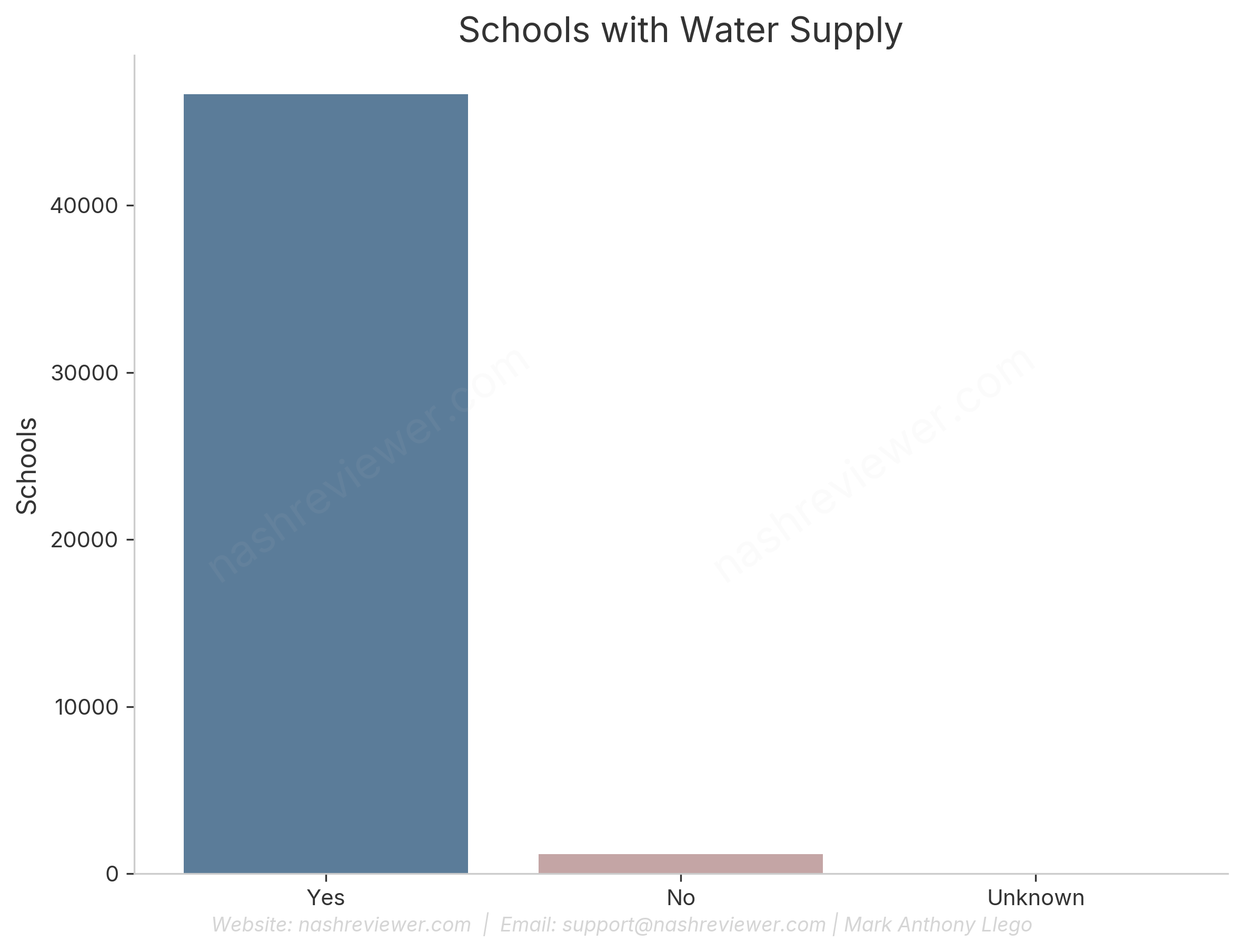 Figure 44. Schools with water supply. 46,657 schools report water supply
access; 1,160 do not.
Figure 44. Schools with water supply. 46,657 schools report water supply
access; 1,160 do not.
ICT Resources and Digital Divide
Data Reconciliation: ICT device counts by type (Table 6) and funding source rely on field name patterns from the inventory system. These are presented as distributions and are not intended to reconcile with the system-wide academic computer total (1,948,140) used for ratio analysis, as devices may be counted in multiple categories.
Table 6. Academic Computer Inventory by Type.
| Type | Academic Count |
|---|
| desktop | 261803 |
| laptop | 231798 |
| all_in_one | 55735 |
| tablet | 1213423 |
| tablet_pc | 286627 |
| virtual_terminal | 185381 |
Table 6 shows tablets as the dominant device class, followed by tablet PCs and desktops. All-in-one desktops are the smallest category. Device-type counts are reported from ICT inventory fields and may not reconcile to the system-wide academic computer total without de-duplication, so treat this as a distribution.
 Figure 30. Computer-to-learner ratio distribution. The distribution is
highly right-skewed: median 23.12 learners per computer with IQR 8.61-66.75,
and mean 66.16, indicating extreme scarcity in a subset of schools.
Figure 30. Computer-to-learner ratio distribution. The distribution is
highly right-skewed: median 23.12 learners per computer with IQR 8.61-66.75,
and mean 66.16, indicating extreme scarcity in a subset of schools.
 Figure 31. Digital divide: schools with academic computers. 11,778 schools
(24.6%) report zero academic computers, while 36,040 have at least one.
Figure 31. Digital divide: schools with academic computers. 11,778 schools
(24.6%) report zero academic computers, while 36,040 have at least one.
 Figure 32. Academic computers by type. Tablets (1,213,423) and tablet PCs
(286,627) dominate the inventory, followed by desktops (261,803), laptops
(231,798), and virtual terminals (185,381); all-in-one devices are the
smallest category (55,735). Counts by type are not intended to reconcile to
the system-wide total without de-duplication.
Figure 32. Academic computers by type. Tablets (1,213,423) and tablet PCs
(286,627) dominate the inventory, followed by desktops (261,803), laptops
(231,798), and virtual terminals (185,381); all-in-one devices are the
smallest category (55,735). Counts by type are not intended to reconcile to
the system-wide total without de-duplication.
 Figure 33. Academic computers by funding source. DepEd and DepEd DCP account
for the largest device volumes (1,782,058 and 1,227,518), followed by LGU
SEF (741,450). Funding-source counts are not mutually exclusive and should
be read as a distribution rather than a reconciled total.
Figure 33. Academic computers by funding source. DepEd and DepEd DCP account
for the largest device volumes (1,782,058 and 1,227,518), followed by LGU
SEF (741,450). Funding-source counts are not mutually exclusive and should
be read as a distribution rather than a reconciled total.
Appendix C provides the tabular values underlying Figure 39.
Personnel and Staffing
Table 7. Teacher Allocation by Level.
| Level | Teachers |
|---|
| Elementary | 537099 |
| Junior High | 310094 |
| Senior High | 88228 |
Table 7 shows elementary teachers as the largest group (57.4%), followed by junior high (33.2%) and senior high (9.4%), mirroring enrollment concentration.
 Figure 34. Schools with and without principals. 26,870 schools (56.2%)
report no principal positions, while 20,948 (43.8%) report at least one.
Figure 34. Schools with and without principals. 26,870 schools (56.2%)
report no principal positions, while 20,948 (43.8%) report at least one.
 Figure 35. Teacher allocation by region. Teacher allocations are largest in
Region IV-A (109,707), Region III (93,327), and Region VI (77,920), with NCR
close behind (77,892), reflecting enrollment concentration.
Figure 35. Teacher allocation by region. Teacher allocations are largest in
Region IV-A (109,707), Region III (93,327), and Region VI (77,920), with NCR
close behind (77,892), reflecting enrollment concentration.
 Figure 36. Teachers by level. Elementary teachers form the majority
(537,099), followed by junior high (310,094) and senior high (88,228).
Figure 36. Teachers by level. Elementary teachers form the majority
(537,099), followed by junior high (310,094) and senior high (88,228).
 Figure 37. Teacher-learner ratio distribution by level. Elementary ratios
center near a median of 21.89, JHS near 20.18, and SHS near 25.80. JHS shows
a wider right tail, reflected by a mean higher than the median.
Figure 37. Teacher-learner ratio distribution by level. Elementary ratios
center near a median of 21.89, JHS near 20.18, and SHS near 25.80. JHS shows
a wider right tail, reflected by a mean higher than the median.
Learners, Enrollment, and Congestion
Table 8. Enrollment by Level.
| Level | Enrollment |
|---|
| Elementary | 14013242 |
| Junior High | 6605539 |
| Senior High | 2606646 |
Table 8 indicates that elementary learners comprise 60.3% of total enrollment, junior high 28.4%, and senior high 11.2%.
Table 9. Ratio Analysis (Learners Coverage).
Note: System-wide ratios are total-weighted (national total learners divided by total resources).
| Ratio | System-wide Ratio | Target (Learners per Unit) | Gap | % of Target | Status |
|---|
| Teacher-Learner Ratio (ES) | 26.09 | 35 | -8.91 | 74.5% | Meets target |
| Teacher-Learner Ratio (JHS) | 21.3 | 35 | -13.7 | 60.9% | Meets target |
| Teacher-Learner Ratio (SHS) | 29.54 | 35 | -5.46 | 84.4% | Meets target |
| Classroom-Learner Ratio | 35.39 | 45 | -9.61 | 78.6% | Meets target |
| Toilet-Learner Ratio | 27.76 | 40 | -12.24 | 69.4% | Meets target |
| Computer-Learner Ratio | 11.92 | 10 | 1.92 | 119.2% | Above target |
Table 9 shows system-wide learners per resource against DepEd planning targets (teacher 1:35, classroom 1:45, toilet 1:40, computer 1:10). Teacher, classroom, and toilet ratios meet targets, while the computer ratio exceeds the 1:10 target, indicating digital congestion.
Interpreting "% of Target": Values below 100% indicate the actual ratio is lower than the maximum allowable, meaning the system has more capacity than the minimum standard. For example, 74.5% for ES Teacher-Learner means schools are using only 74.5% of the permitted class size (26.09 vs 35 learners per teacher), which is favorable. A value above 100% (e.g., Computer-Learner at 119.2%) indicates the ratio exceeds the target, meaning resource scarcity.
Regional Comparisons
Table 10. Regional Comparison (Enrollment Coverage).
| Region | Schools | Buildings | Teachers | Enrollment | Good % | Critical % |
|---|
| BARMM | 2,603 | 10,220 | 30,231 | 913,414 | 19.5% | 6.1% |
| CAR | 1,844 | 8,283 | 19,196 | 358,204 | 31.8% | 11.6% |
| CARAGA | 2,099 | 13,790 | 32,026 | 700,496 | 24.6% | 7.9% |
| MIMAROPA | 2,382 | 16,123 | 35,108 | 817,395 | 30.7% | 5.2% |
| NCR | 828 | 4,175 | 77,892 | 2,101,985 | 53.1% | 5.0% |
| Region I | 2,861 | 21,868 | 49,584 | 1,101,162 | 31.4% | 9.9% |
| Region II | 2,539 | 18,230 | 37,598 | 809,342 | 28.7% | 9.1% |
| Region III | 3,729 | 30,472 | 93,327 | 2,478,610 | 43.1% | 8.8% |
| Region IV-A | 3,565 | 29,330 | 109,707 | 3,188,202 | 31.5% | 11.4% |
| Region IX | 2,546 | 15,164 | 40,837 | 961,868 | 29.6% | 8.6% |
| Region V | 3,862 | 29,092 | 69,354 | 1,581,329 | 29.1% | 7.3% |
| Region VI | 4,057 | 33,264 | 77,920 | 1,809,425 | 24.1% | 5.3% |
| Region VII | 3,820 | 24,460 | 73,283 | 1,822,084 | 27.7% | 7.3% |
| Region VIII | 4,179 | 23,923 | 55,650 | 1,141,816 | 27.6% | 5.2% |
| Region X | 2,531 | 17,730 | 44,970 | 1,159,212 | 20.9% | 20.0% |
| Region XI | 2,218 | 16,316 | 46,748 | 1,218,778 | 29.2% | 11.9% |
| Region XII | 2,155 | 15,324 | 41,990 | 1,062,105 | 29.6% | 9.8% |
Table 10 replicates the regional building condition profile and provides the baseline counts for regional staffing, enrollment, and infrastructure comparisons.
 Figure 38. Regional enrollment per school. Enrollment per school peaks in
NCR (2,539), followed by Region IV-A (894) and Region III (665). Lowest
levels appear in CAR (194) and Region VIII (273).
Figure 38. Regional enrollment per school. Enrollment per school peaks in
NCR (2,539), followed by Region IV-A (894) and Region III (665). Lowest
levels appear in CAR (194) and Region VIII (273).
 Figure 39. Infrastructure quality index by region. Infrastructure quality is
highest in NCR (0.878) and Region III (0.842), while Region X (0.716) and
BARMM (0.733) are lowest.
Figure 39. Infrastructure quality index by region. Infrastructure quality is
highest in NCR (0.878) and Region III (0.842), while Region X (0.716) and
BARMM (0.733) are lowest.
 Figure 40. Regional teacher-learner ratios. Highest learner loads per
teacher occur in BARMM (30.21) and Region IV-A (29.06), while CAR (18.66)
shows the lowest regional ratio.
Figure 40. Regional teacher-learner ratios. Highest learner loads per
teacher occur in BARMM (30.21) and Region IV-A (29.06), while CAR (18.66)
shows the lowest regional ratio.
Multivariate Correlations and Infrastructure Quality
Table 11. Correlation Matrix (Pearson).
| Metric | enrollment_total | teachers_total | classrooms_instructional_total | computers_academic_total | toilets_functional_total | buildings_total | buildings_needs_repair | buildings_critical | building_condition_index | infrastructure_quality_index |
|---|
| enrollment_total | 1 | 0.951694 | 0.887414 | 0.384266 | 0.740571 | 0.604177 | 0.417434 | 0.212616 | 0.0803139 | 0.15652 |
| teachers_total | 0.951694 | 1 | 0.888982 | 0.407558 | 0.735746 | 0.612953 | 0.435204 | 0.196576 | 0.077231 | 0.151173 |
| classrooms_instructional_total | 0.887414 | 0.888982 | 1 | 0.326608 | 0.83925 | 0.751567 | 0.547946 | 0.206299 | 0.0960876 | 0.188586 |
| computers_academic_total | 0.384266 | 0.407558 | 0.326608 | 1 | 0.272712 | 0.139144 | 0.0869353 | 0.0256744 | 0.0541591 | 0.0793027 |
| toilets_functional_total | 0.740571 | 0.735746 | 0.83925 | 0.272712 | 1 | 0.705727 | 0.496582 | 0.240387 | 0.0886346 | 0.188298 |
| buildings_total | 0.604177 | 0.612953 | 0.751567 | 0.139144 | 0.705727 | 1 | 0.764505 | 0.377586 | 0.0117562 | 0.141193 |
| buildings_needs_repair | 0.417434 | 0.435204 | 0.547946 | 0.0869353 | 0.496582 | 0.764505 | 1 | 0.10288 | -0.244969 | -0.0818918 |
| buildings_critical | 0.212616 | 0.196576 | 0.206299 | 0.0256744 | 0.240387 | 0.377586 | 0.10288 | 1 | -0.383355 | -0.220331 |
| building_condition_index | 0.0803139 | 0.077231 | 0.0960876 | 0.0541591 | 0.0886346 | 0.0117562 | -0.244969 | -0.383355 | 1 | 0.763017 |
| infrastructure_quality_index | 0.15652 | 0.151173 | 0.188586 | 0.0793027 | 0.188298 | 0.141193 | -0.0818918 | -0.220331 | 0.763017 | 1 |
Table 11 shows strong scale correlations (enrollment-teachers 0.95, enrollment-classrooms 0.89, classrooms-toilets 0.84) and weaker links between scale and infrastructure quality (enrollment-infrastructure quality 0.16). Infrastructure quality tracks building condition (0.76) and declines as critical buildings increase (building condition vs critical -0.38).
 Figure 7. Correlation heatmap (Pearson) for composite section. Strong
positive correlations link enrollment with teachers (0.95) and classrooms
(0.89). Building condition and infrastructure quality are also strongly
aligned (0.76), while critical buildings are negatively correlated with
building condition (-0.38).
Figure 7. Correlation heatmap (Pearson) for composite section. Strong
positive correlations link enrollment with teachers (0.95) and classrooms
(0.89). Building condition and infrastructure quality are also strongly
aligned (0.76), while critical buildings are negatively correlated with
building condition (-0.38).
 Figure 8. PCA analysis (2 components). The PCA projection shows a continuous
spread of schools across the first two components, indicating gradual
multivariate variation rather than sharp cluster boundaries.
Figure 8. PCA analysis (2 components). The PCA projection shows a continuous
spread of schools across the first two components, indicating gradual
multivariate variation rather than sharp cluster boundaries.
 Figure 9. Correlation heatmap (Pearson). This heatmap mirrors Figure 7 and
reinforces the high scale correlations and weak association between
enrollment and infrastructure quality.
Figure 9. Correlation heatmap (Pearson). This heatmap mirrors Figure 7 and
reinforces the high scale correlations and weak association between
enrollment and infrastructure quality.
Hypothesis Tests
Table 16. Hypothesis Tests with Effect Sizes.
| Test | Statistic | p-value | p-adj FDR | p-adj Bonferroni | Effect Size | Effect Label | Assumptions |
|---|
| Chi-square: Internet vs Management | 7.0294 | 0.0298 | 0.0298 | 0.0893 | 0.0121 | Cramer's V | low_expected_cells=3 |
| Mann-Whitney U: ES Teacher Ratio by Internet | 1.75406e+08 | 0 | 0 | 0 | -0.2606 | Rank-biserial r | non-normal or small sample |
| Z-test: Water Supply Full Coverage | -34.4796 | 0 | 0 | 0 | -0.3128 | Cohen's h | nobs=47817 |
Table 16 indicates a statistically significant association between internet availability and school management (chi-square p=0.0298, very small effect). Elementary teacher-learner ratios differ by internet availability (Mann-Whitney p<0.001, rank-biserial r=-0.2606). The water supply coverage is significantly below full coverage (z-test p<0.001, Cohen h=-0.3128).
Effect Size Interpretation Guide:
- Cramer's V: ≤0.10 = negligible, 0.10-0.30 = small, 0.30-0.50 = medium, ≥0.50 = large
- Rank-biserial r: ±0.10 = small, ±0.30 = medium, ±0.50 = large
- Cohen's h: ±0.20 = small, ±0.50 = medium, ±0.80 = large
Based on these benchmarks: the internet-management association (V=0.0121) is negligible; the ES teacher ratio difference by internet (r=-0.2606) is small; and the water coverage gap (h=-0.3128) is small-to-medium.
Practical Significance Note: While the chi-square (internet vs. management) and Mann-Whitney (ES teacher ratio by internet) tests achieve statistical significance due to the large sample size (n=47,818), their negligible-to-small effect sizes indicate limited practical relevance for policy decisions. The water coverage gap (h=-0.3128) represents a small-to-medium effect with more actionable implications for infrastructure planning.
Distribution Diagnostics
Table 17. Distribution Fit Summary.
| Metric | Best Distribution | AIC | N | Parameters | Sample Note |
|---|
| enrollment_total | lognorm | 672655 | 47814 | 1.0869, 0.1978, 252.5906 | positive_only |
| teachers_total | lognorm | 361021 | 47682 | 0.9479, 0.5032, 11.2481 | positive_only |
| classrooms_instructional_total | lognorm | 329563 | 46942 | 0.8945, 0.1362, 9.0500 | positive_only |
| computers_academic_total | lognorm | 137425 | 36040 | 12.7482, 1.0000, 0.1277 | positive_only |
| toilets_functional_total | lognorm | 355016 | 46456 | 0.9597, -0.1688, 11.5090 | positive_only |
| buildings_total | lognorm | 261468 | 47185 | 0.6199, -0.6116, 6.2335 | positive_only |
| buildings_needs_repair | lognorm | 5451.24 | 41735 | 12.8014, 1.0000, 0.0202 | positive_only |
| buildings_critical | lognorm | -404838 | 13766 | 18.2778, 1.0000, 0.0000 | positive_only |
| building_condition_index | normal | -19411.6 | 47101 | 0.6416, 0.1969 | positive_only |
| infrastructure_quality_index | normal | -54577.3 | 47778 | 0.7766, 0.1367 | positive_only |
Table 17 shows that most count-based indicators follow lognormal distributions, while composite indices (building condition and infrastructure quality) are best approximated by normal distributions. This supports the use of non-parametric tests and highlights skewed resource distributions.
 Figure 10. Distribution fit: building_condition_index. The best fit is
normal (Table 17), centered near 0.641 with median 0.65 and IQR 0.50-0.775.
Figure 10. Distribution fit: building_condition_index. The best fit is
normal (Table 17), centered near 0.641 with median 0.65 and IQR 0.50-0.775.
 Figure 11. Distribution fit: buildings_critical. The lognormal fit reflects
heavy right skew, indicating most schools have few critical buildings while
a smaller set has high critical counts.
Figure 11. Distribution fit: buildings_critical. The lognormal fit reflects
heavy right skew, indicating most schools have few critical buildings while
a smaller set has high critical counts.
 Figure 12. Distribution fit: buildings_needs_repair. The lognormal fit
indicates a skewed maintenance backlog, with most schools having modest
needs and a subset carrying large repair burdens.
Figure 12. Distribution fit: buildings_needs_repair. The lognormal fit
indicates a skewed maintenance backlog, with most schools having modest
needs and a subset carrying large repair burdens.
 Figure 13. Distribution fit: buildings_total. Total buildings per school
follow a lognormal pattern, consistent with the system having many small
campuses and a few large ones.
Figure 13. Distribution fit: buildings_total. Total buildings per school
follow a lognormal pattern, consistent with the system having many small
campuses and a few large ones.
 Figure 14. Distribution fit: classrooms_instructional_total. Instructional
classroom counts are lognormal, suggesting substantial right skew in
facility capacity across schools.
Figure 14. Distribution fit: classrooms_instructional_total. Instructional
classroom counts are lognormal, suggesting substantial right skew in
facility capacity across schools.
 Figure 15. Distribution fit: computers_academic_total. Academic computer
counts are lognormal, indicating unequal device distribution across schools.
Figure 15. Distribution fit: computers_academic_total. Academic computer
counts are lognormal, indicating unequal device distribution across schools.
 Figure 16. Distribution fit: enrollment_total. Enrollment totals are
lognormal, reflecting a concentration of large student populations in a
smaller number of schools.
Figure 16. Distribution fit: enrollment_total. Enrollment totals are
lognormal, reflecting a concentration of large student populations in a
smaller number of schools.
 Figure 17. Distribution fit: infrastructure_quality_index. The
infrastructure quality index is best fit by a normal distribution, with mean
0.776 and median 0.79.
Figure 17. Distribution fit: infrastructure_quality_index. The
infrastructure quality index is best fit by a normal distribution, with mean
0.776 and median 0.79.
 Figure 18. Distribution fit: teachers_total. Teacher counts follow a
lognormal distribution, indicating skewed staffing levels across schools.
Figure 18. Distribution fit: teachers_total. Teacher counts follow a
lognormal distribution, indicating skewed staffing levels across schools.
 Figure 19. Distribution fit: toilets_functional_total. Functional toilet
counts are lognormal, underscoring uneven sanitation capacity across
schools.
Figure 19. Distribution fit: toilets_functional_total. Functional toilet
counts are lognormal, underscoring uneven sanitation capacity across
schools.
 Figure 20. Q-Q plot: building_condition_index. Points align more closely to
the reference line than count variables, consistent with the normal fit in
Table 17.
Figure 20. Q-Q plot: building_condition_index. Points align more closely to
the reference line than count variables, consistent with the normal fit in
Table 17.
 Figure 21. Q-Q plot: buildings_critical. Strong departures from the
reference line confirm non-normality and support the lognormal fit.
Figure 21. Q-Q plot: buildings_critical. Strong departures from the
reference line confirm non-normality and support the lognormal fit.
 Figure 22. Q-Q plot: buildings_needs_repair. Deviations from the line
indicate right-skewed distributions, aligned with the lognormal fit.
Figure 22. Q-Q plot: buildings_needs_repair. Deviations from the line
indicate right-skewed distributions, aligned with the lognormal fit.
 Figure 23. Q-Q plot: buildings_total. Non-linear departures from the line
indicate skewed building counts across schools.
Figure 23. Q-Q plot: buildings_total. Non-linear departures from the line
indicate skewed building counts across schools.
 Figure 24. Q-Q plot: classrooms_instructional_total. The plot departs from
normality, consistent with the lognormal fit for classroom counts.
Figure 24. Q-Q plot: classrooms_instructional_total. The plot departs from
normality, consistent with the lognormal fit for classroom counts.
 Figure 25. Q-Q plot: computers_academic_total. The Q-Q pattern shows
substantial right skew in device availability.
Figure 25. Q-Q plot: computers_academic_total. The Q-Q pattern shows
substantial right skew in device availability.
 Figure 26. Q-Q plot: enrollment_total. The plot confirms non-normality and
heavy tails in enrollment distribution.
Figure 26. Q-Q plot: enrollment_total. The plot confirms non-normality and
heavy tails in enrollment distribution.
 Figure 27. Q-Q plot: infrastructure_quality_index. Points follow the
reference line more closely than the count indicators, supporting a
near-normal distribution.
Figure 27. Q-Q plot: infrastructure_quality_index. Points follow the
reference line more closely than the count indicators, supporting a
near-normal distribution.
 Figure 28. Q-Q plot: teachers_total. The Q-Q plot shows pronounced right
skew, consistent with the lognormal fit.
Figure 28. Q-Q plot: teachers_total. The Q-Q plot shows pronounced right
skew, consistent with the lognormal fit.
 Figure 29. Q-Q plot: toilets_functional_total. Deviation from the reference
line indicates non-normality in sanitation counts.
Figure 29. Q-Q plot: toilets_functional_total. Deviation from the reference
line indicates non-normality in sanitation counts.
Cluster Analysis
Table 18. Cluster Validation Metrics.
| Method | Silhouette | Davies-Bouldin | Calinski-Harabasz | Sample Size |
|---|
| kmeans | 0.2691 | 1.2537 | 1719.73 | 5000 |
| hierarchical | 0.1863 | 1.4497 | 1322.37 | 5000 |
Table 18 shows modest clustering structure. K-means achieves a higher silhouette (0.2691) than hierarchical clustering (0.1863), while hierarchical clustering has a higher Davies-Bouldin score (1.4497), indicating weaker separation across resource profiles.
 Figure 5. Cluster validation metrics (k-means vs hierarchical). K-means
yields a higher silhouette score (0.2691) than hierarchical clustering
(0.1863) and a lower Davies-Bouldin score (1.2537 vs 1.4497), indicating
slightly better separation.
Figure 5. Cluster validation metrics (k-means vs hierarchical). K-means
yields a higher silhouette score (0.2691) than hierarchical clustering
(0.1863) and a lower Davies-Bouldin score (1.2537 vs 1.4497), indicating
slightly better separation.
 Figure 6. Hierarchical clustering dendrogram (Sample). The dendrogram shows
gradual merging without large gaps, consistent with modest clustering
structure in the validation metrics.
Figure 6. Hierarchical clustering dendrogram (Sample). The dendrogram shows
gradual merging without large gaps, consistent with modest clustering
structure in the validation metrics.
Enrollment Time Series
Table 14. Enrollment Time Series (National).
| School Year | Schools | Enrollment Total | YoY Change | YoY Change % |
|---|
| 2017-18 | 46,815 | 22,096,820 | NA | NA |
| 2018-19 | 47,025 | 22,558,138 | 461,318 | 2.09% |
| 2019-20 | 47,188 | 22,572,923 | 14,785 | 0.07% |
| 2020-21 | 47,421 | 22,712,409 | 139,486 | 0.62% |
| 2021-22 | 47,553 | 24,127,495 | 1,415,086 | 6.23% |
| 2022-23 | 47,678 | 24,036,251 | -91,244 | -0.38% |
| 2023-24 | 47,818 | 23,225,427 | -810,824 | -3.37% |
| 2024-25 | 47,972 | 22,543,711 | -681,716 | -2.94% |
Table 14 shows national enrollment peaking at 24.1M in 2021-22 (+6.23% YoY), followed by three consecutive years of decline: 2022-23 (-0.38%), 2023-24 (-3.37%), and 2024-25 (-2.94%).
Table 15. Enrollment Time Series (Top Regions).
| Region | School Year | Schools | Enrollment Total | YoY Change | YoY Change % |
|---|
| Region IV-A | 2024-25 | 3,575 | 3,094,057 | -94,145 | -2.95% |
| Region III | 2024-25 | 3,743 | 2,413,229 | -65,381 | -2.64% |
| NCR | 2024-25 | 828 | 2,031,877 | -70,108 | -3.34% |
| Region V | 2024-25 | 3,874 | 1,522,912 | -58,417 | -3.69% |
| Region VII | 2024-25 | 2,828 | 1,407,043 | -415,041 | -22.78% |
| Region XI | 2024-25 | 2,227 | 1,186,639 | -32,139 | -2.64% |
| Region X | 2024-25 | 2,536 | 1,136,534 | -22,678 | -1.96% |
| Region VIII | 2024-25 | 4,191 | 1,099,780 | -42,036 | -3.68% |
| NIR | 2024-25 | 2,242 | 1,099,410 | NA | NA |
| Region I | 2024-25 | 2,865 | 1,058,957 | -42,205 | -3.83% |
Table 15 highlights recent declines across top regions. Region VII shows the largest YoY drop in 2024-25 (-22.78%), partly reflecting the administrative transfer of Negros Oriental and Siquijor to NIR. NIR appears with NA YoY values due to missing prior-year observations.
Table 19. Enrollment Time Series Trend Statistics.
| Start Year | End Year | Years | Start Enrollment | End Enrollment | CAGR | Linear Slope/Year | R-squared | p-value |
|---|
| 2017 | 2024 | 7 | 22,096,820 | 22,543,711 | 0.29% | 146,068 | 0.2311 | 0.2279 |
Table 19 reports a national CAGR of 0.29% from 2017 to 2024 with a moderate linear slope (146,068 learners per year) and a low R-squared (0.2311), indicating substantial year-to-year variation around the trend.
Table 20. Enrollment CAGR by Region.
| Region | Start Year | End Year | Years | Start Enrollment | End Enrollment | CAGR | Linear Slope/Year | R-squared | p-value |
|---|
| ARMM | 2017 | 2018 | 1 | 743,947 | 758,448 | 1.95% | 14,501 | 1.0000 | 0.0000 |
| BARMM | 2019 | 2024 | 5 | 771,584 | 919,666 | 3.57% | 35,978 | 0.6901 | 0.0406 |
| CAR | 2017 | 2024 | 7 | 344,949 | 345,523 | 0.02% | 1,639 | 0.1133 | 0.4149 |
| CARAGA | 2017 | 2024 | 7 | 684,258 | 686,161 | 0.04% | 1,211 | 0.0234 | 0.7174 |
| MIMAROPA | 2017 | 2024 | 7 | 791,415 | 795,865 | 0.08% | 3,257 | 0.1106 | 0.4209 |
| NCR | 2017 | 2024 | 7 | 2,037,324 | 2,031,877 | -0.04% | 7,556 | 0.0903 | 0.4695 |
| NIR | 2024 | 2024 | 0 | 1,099,410 | 1,099,410 | NA | NA | NA | NA |
| Region I | 2017 | 2024 | 7 | 1,107,848 | 1,058,957 | -0.64% | -3,669 | 0.0630 | 0.5486 |
| Region II | 2017 | 2024 | 7 | 764,900 | 778,723 | 0.26% | 4,635 | 0.1525 | 0.3388 |
| Region III | 2017 | 2024 | 7 | 2,293,935 | 2,413,229 | 0.73% | 26,926 | 0.4656 | 0.0623 |
| Region IV-A | 2017 | 2024 | 7 | 2,841,413 | 3,094,057 | 1.22% | 51,000 | 0.6180 | 0.0207 |
| Region IX | 2017 | 2024 | 7 | 911,187 | 938,189 | 0.42% | 6,252 | 0.2369 | 0.2213 |
| Region V | 2017 | 2024 | 7 | 1,607,628 | 1,522,912 | -0.77% | -6,855 | 0.0916 | 0.4661 |
| Region VI | 2017 | 2024 | 7 | 1,788,189 | 995,386 | -8.03% | -62,637 | 0.2586 | 0.1981 |
| Region VII | 2017 | 2024 | 7 | 1,725,920 | 1,407,043 | -2.88% | -17,243 | 0.0782 | 0.5024 |
| Region VIII | 2017 | 2024 | 7 | 1,164,089 | 1,099,780 | -0.81% | -5,782 | 0.1345 | 0.3716 |
| Region X | 2017 | 2024 | 7 | 1,084,451 | 1,136,534 | 0.67% | 10,031 | 0.4332 | 0.0760 |
| Region XI | 2017 | 2024 | 7 | 1,129,131 | 1,186,639 | 0.71% | 13,392 | 0.4093 | 0.0876 |
| Region XII | 2017 | 2024 | 7 | 1,076,236 | 1,033,760 | -0.57% | -6,847 | 0.3237 | 0.1411 |
Table 20 shows positive long-run growth for BARMM (3.57%), Region IV-A (1.22%), and Region III (0.73%), with negative CAGRs in Regions VI (-8.03%) and VII (-2.88%). NIR is a single-year entry with NA trend metrics, and several regions have non-significant p-values, so trends should be interpreted cautiously.
Note on CAGR vs Linear Slope Discrepancies: Some regions (e.g., NCR) show a negative CAGR but a positive linear slope, or vice versa. This occurs when enrollment trends are non-linear—for example, a mid-period peak (2022-23) can pull the OLS linear trend upward even when the endpoints decline. CAGR is an endpoint-based geometric measure, while linear slope is an OLS fit across all data points. Low R-squared values indicate poor linear fit and suggest non-linear dynamics. Both metrics should be interpreted together.
⚠️ Important Note on Region VI, Region VII, and NIR: The -8.03% CAGR for Region VI and the sharp 2024-25 decline in Region VII are significantly affected by the creation of Negros Island Region (NIR) in 2024, which transferred Negros Occidental (from Region VI) and Negros Oriental/Siquijor (from Region VII) to the new region. The apparent declines do not reflect learner attrition but administrative reorganization. Direct comparisons for Regions VI and VII should account for this boundary change. NIR appears as a single-year entry (2024-25 only) and cannot support trend analysis.
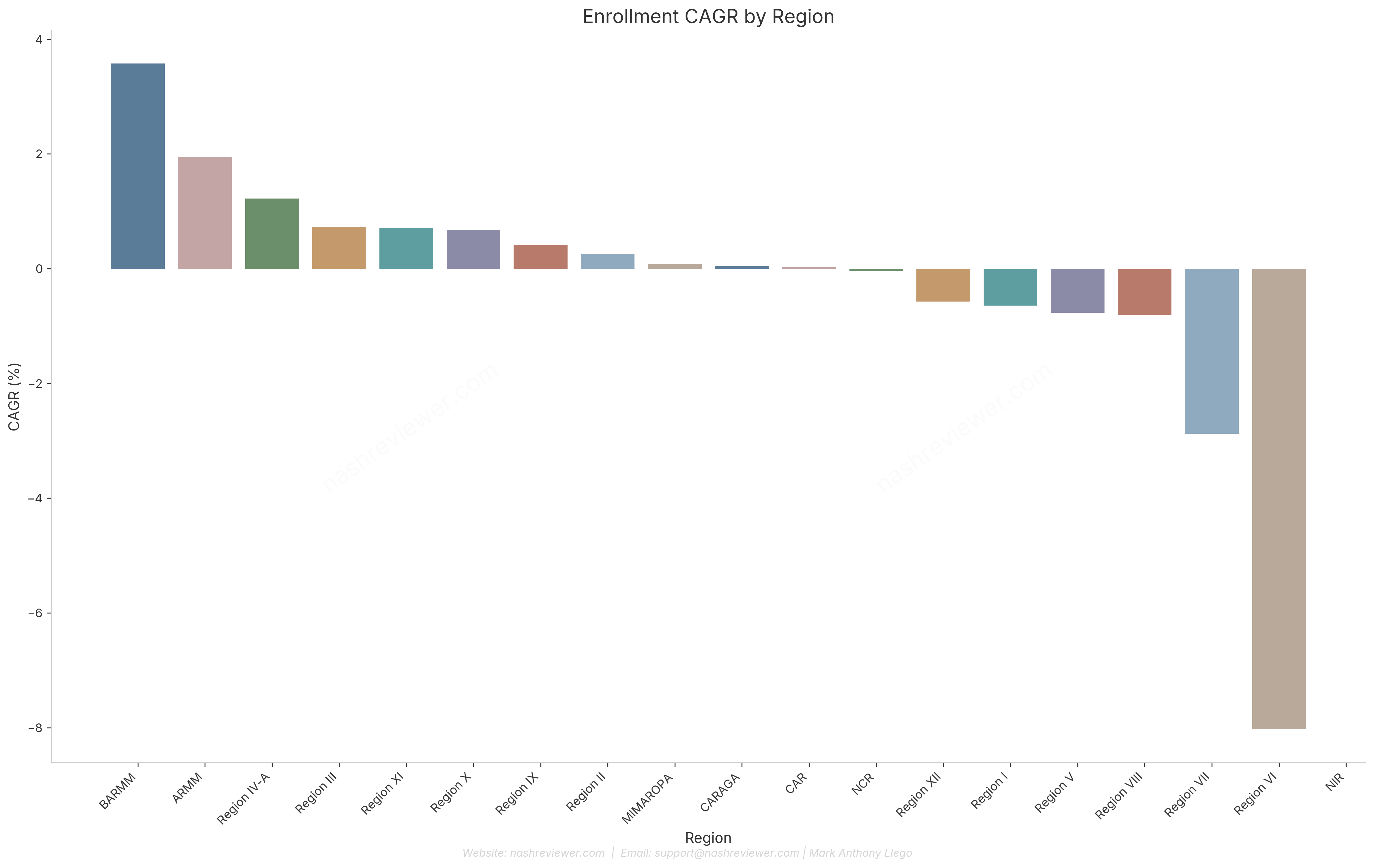 Figure 45. Enrollment CAGR by region. BARMM (3.57%), Region IV-A (1.22%),
and Region III (0.73%) lead positive growth, while Region VI (-8.03%) and
Region VII (-2.88%) show steep declines.
Figure 45. Enrollment CAGR by region. BARMM (3.57%), Region IV-A (1.22%),
and Region III (0.73%) lead positive growth, while Region VI (-8.03%) and
Region VII (-2.88%) show steep declines.
 Figure 46. National enrollment trend. Enrollment rises to a 2022-23 peak
then declines in 2023-24 and 2024-25; the linear trend shows a modest
positive slope (131,407 per year) with low explanatory power (R-squared
0.3021).
Figure 46. National enrollment trend. Enrollment rises to a 2022-23 peak
then declines in 2023-24 and 2024-25; the linear trend shows a modest
positive slope (131,407 per year) with low explanatory power (R-squared
0.3021).
 Figure 47. Top regions enrollment trend. Top regions track similar patterns
of post-2022-23 decline, with Region VII showing the largest recent drop.
Figure 47. Top regions enrollment trend. Top regions track similar patterns
of post-2022-23 decline, with Region VII showing the largest recent drop.
 Figure 48. National enrollment YoY change. YoY change peaks at +6.23% in
2021-22, followed by three consecutive years of decline: -0.38% (2022-23),
-3.37% (2023-24), and -2.94% (2024-25).
Figure 48. National enrollment YoY change. YoY change peaks at +6.23% in
2021-22, followed by three consecutive years of decline: -0.38% (2022-23),
-3.37% (2023-24), and -2.94% (2024-25).
Integrated Findings: Infrastructure Health, Congestion, and Service Gaps
- Infrastructure health is the largest constraint: only 29.6% of buildings are in good condition, while 60.8% need repair and 8.8% are critical.
- Congestion concentrates in high-enrollment regions: NCR, Region IV-A, and Region III have the highest enrollment per school; BARMM has the highest regional teacher-learner ratio.
- Service gaps are most pronounced in digital access: 21.9% of schools lack internet and 24.6% have zero academic computers. Among schools with academic computers, the median ratio is 23 learners per academic computer.
- Multivariate correlations show scale drives staffing and classroom supply, but infrastructure quality and building condition do not scale proportionally with enrollment, reinforcing the need for targeted capital programs.
- Regional infrastructure quality indices range from 0.716 (Region X) to 0.878 (NCR), indicating a sizable quality gap that overlays congestion and utility deficits.
Limitations and Data Notes
Data Quality Considerations: All data are self-reported through the DepEd Learner Information System (LIS) and may contain reporting errors. A small number of schools report zero teachers or zero enrollment, which may reflect data entry issues rather than actual conditions.
- Ratios are computed using learners coverage; in this release, learners totals align with enrollment totals, so coverage gaps are not observed, but this should be rechecked if future releases diverge.
- ICT device counts by type and funding source rely on field name patterns and should be interpreted as distributions rather than reconciliations to the system-wide total used in ratio analysis.
- Time series estimates depend on available enrollment files and may omit intermediate years (notably 2021-22); single-year regions (e.g., NIR) cannot support CAGR estimation.
- Administrative boundary changes: The creation of NIR in 2024 significantly affects Region VI time series. CAGR for Region VI should not be interpreted as learner attrition.
- Correlations describe association, not causality; infrastructure investment priorities should be validated with on-the-ground verification.
- Scope: This report covers public schools only. Private school data was excluded from this analysis.
Appendix A: Chart Index
Appendix B: Statistical Methods Summary
| Method | Purpose | Notes |
|---|
| Descriptive statistics | Summarize distributions (count, mean, median, mode, std, min/max, skewness, kurtosis, percentiles, IQR, CV) | Computed across numeric indicators |
| Ratio analysis | Compute learner-to-resource ratios | Uses learners coverage when available |
| Pearson correlation | Measure linear association | Reported in Table 11 |
| Spearman correlation | Measure rank-based association | Computed for robustness |
| Linear regression (OLS, robust SE) | Model enrollment vs resources | HC3 robust standard errors |
| Logistic regression | Model internet availability vs staffing/ICT | Run when class counts are sufficient |
| Chi-square test | Internet vs school management association | Cramer's V effect size |
| t-test / Welch t-test | ES teacher ratio differences by management | Used when normality holds |
| Mann-Whitney U test | ES teacher ratio differences by internet | Non-parametric alternative |
| ANOVA | ES teacher ratio differences by management | Used when normality/variance hold |
| Kruskal-Wallis test | ES teacher ratio differences by management | Non-parametric alternative |
| Proportion z-test | Test full water-supply coverage | Cohen's h effect size |
| Normality tests | Diagnose distributional assumptions | Shapiro-Wilk, D'Agostino K^2, Lilliefors |
| Distribution fitting | Select best-fit distribution | Normal, lognormal, gamma via AIC |
| PCA | Reduce dimensionality | Two-component projection |
| Factor analysis | Identify latent structure | Convergence tracked when applicable |
| Clustering | Group schools by resource profiles | K-means and hierarchical (Ward) |
| Cluster validation | Assess cluster quality | Silhouette, Davies-Bouldin, Calinski-Harabasz |
| Outlier detection | Identify extreme schools | Z-score, IQR, Isolation Forest, DBSCAN |
| Gini coefficient | Measure resource inequality | Teachers, classrooms, computers |
| Time-series trends | Track enrollment change | YoY change, CAGR, linear trend regression |
Appendix C: Infrastructure Quality Index by Region
Table 21. Infrastructure Quality Index by Region (Mean, SY 2023-2024).
| Region | Infrastructure Quality Index (Mean) |
|---|
| BARMM | 0.733 |
| CAR | 0.750 |
| CARAGA | 0.773 |
| MIMAROPA | 0.767 |
| NCR | 0.878 |
| Region I | 0.806 |
| Region II | 0.794 |
| Region III | 0.842 |
| Region IV-A | 0.800 |
| Region IX | 0.743 |
| Region V | 0.762 |
| Region VI | 0.772 |
| Region VII | 0.778 |
| Region VIII | 0.774 |
| Region X | 0.716 |
| Region XI | 0.765 |
| Region XII | 0.765 |
Technical Notes
Data Sources:
- Source: Department of Education - Learner Information System (LIS)
- School Year: 2023-24
- Data Files:
- facilities_2023-24.csv.gz
- sanitation_utilities_2023-24.csv.gz
- ict_2023-24.csv.gz
- personnel_2023-24.csv.gz
- enrollment_2023-24.csv.gz
- learners_2023-24.csv.gz
- enrollment_2017-18.csv.gz
- enrollment_2018-19.csv.gz
- enrollment_2019-20.csv.gz
- enrollment_2020-21.csv.gz
- enrollment_2022-23.csv.gz
- enrollment_2024-25.csv.gz
Analytical Methods:
- Merge datasets by
school_id and filter to the Public sector.
- Derive totals for teachers, classrooms, buildings, computers, toilets, and enrollment.
- Compute building condition, utility availability, and infrastructure quality indices.
- Calculate learner-to-resource ratios by level and system-wide weighted ratios.
- Aggregate metrics by region for comparative analysis.
- Apply statistical tests, distribution diagnostics, clustering, and time-series analyses as summarized in Appendix B.